Claude Fable 5 vs GPT-5.6: The Latest-vs-Latest Flagship Comparison
This is the comparison that matters: the best model Anthropic ships against the best OpenAI ships, as of July 2026. On one side, Claude Fable 5 — Anthropic's most capable model, a single premium tier. On the other, GPT-5.6 — not one model but a family of three: Sol (flagship), Terra (balanced), and Luna (cost tier).
The lazy version of this comparison picks a winner. The honest version notices that these two are built on different philosophies — one peak versus a range — and that the "winner" depends entirely on what you're doing. Neither sweeps. They split, and the split is remarkably clean.
Neither one sweeps
Put the flagship against the flagship — Fable 5 against GPT-5.6 Sol, the family's top tier — and the benchmarks trade blows.
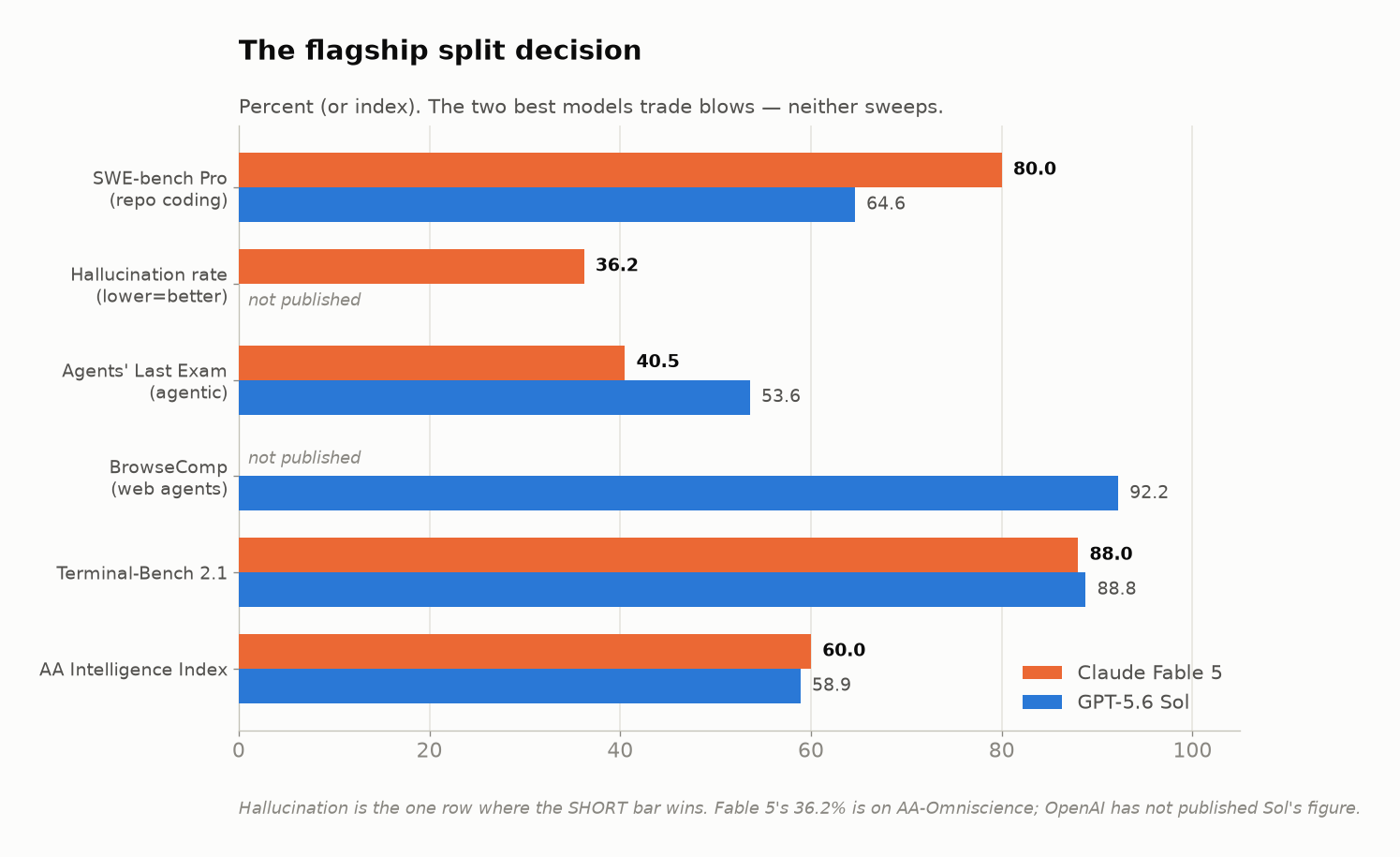
Read across the rows and a pattern emerges immediately. Fable 5 dominates repo-scale coding — 80.0% on SWE-bench Pro against Sol's 64.6%, a 15-point gap on the benchmark that best mirrors real software work. It also edges the overall Artificial Analysis Intelligence Index, 60 to 58.9, making it — narrowly — the single most capable model on the board.
GPT-5.6 Sol dominates autonomous agents and browsing — 53.6 to 40.5 on Agents' Last Exam, and a state-of-the-art 92.2% on BrowseComp, a web-agent benchmark where Anthropic hasn't published a Fable 5 figure at all. Terminal-Bench is effectively a tie (88.0 vs 88.8).
Fable 5 is the deeper model on a single hard problem. GPT-5.6 is the broader model across many autonomous ones. That is the entire comparison in one sentence.
Who wins what
Line the categories up and the division of territory is almost suspiciously tidy.
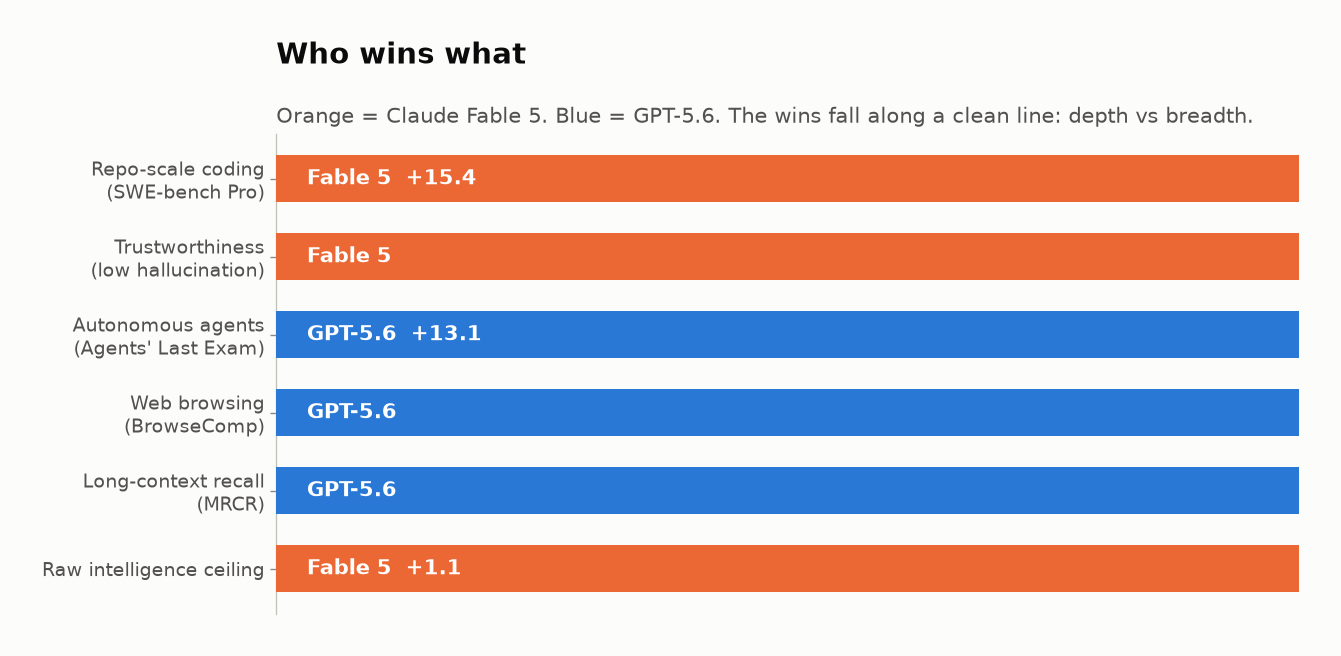
Anthropic's model wins where the task is deep: writing correct code across a large repository, and — critically — knowing when it doesn't know. On AA-Omniscience, which measures how often a model answers confidently and wrongly, Fable 5 hallucinates 36.2% of the time. OpenAI hasn't published Sol's number, but its predecessor GPT-5.5 sat above 85% on the same test, and hallucination is not a metric that leaps a generation easily. If your system reports findings a human will act on, that gap is the most important number in this entire post.
OpenAI's model wins where the task is broad and autonomous: long chains of tool calls, browsing the live web, and holding enormous context. Which brings us to the two places the GPT-5.6 family pulls decisively ahead.
Long context is GPT-5.6's home turf
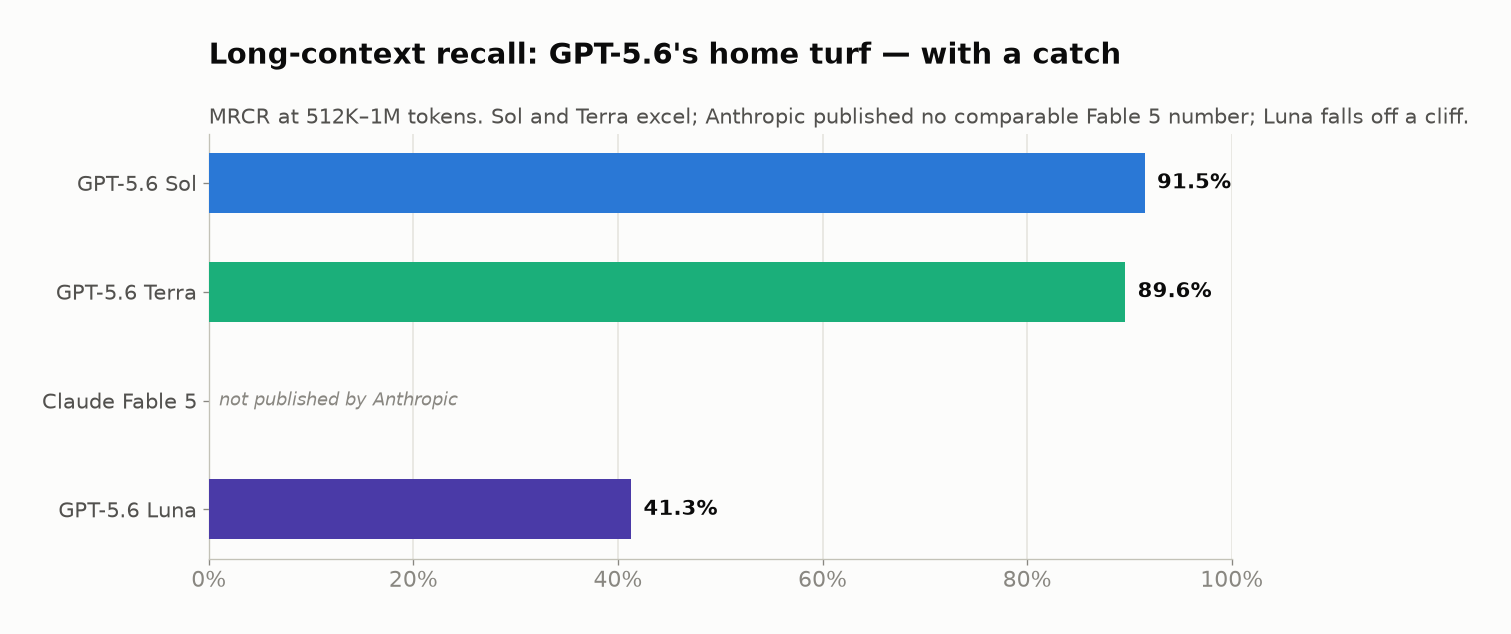
On MRCR recall across the 512K-to-1M token range, Sol scores 91.5% and Terra 89.6%. Anthropic publishes a 1M context window for Fable 5 but no comparable long-context recall figure — so on the one benchmark that tells you whether a million-token window actually works at a million tokens, GPT-5.6 has hard numbers and Fable 5 has a spec sheet. (Note the trap: Luna, the cheap tier, collapses to 41.3% here. A big context window is a Sol-and-Terra feature, not a whole-family one.)
The real structural difference: one model vs a lineup
Everything above compares Fable 5 to Sol, the top of the GPT-5.6 family. But that undersells OpenAI's actual advantage, which isn't a benchmark — it's the shape of the offering.
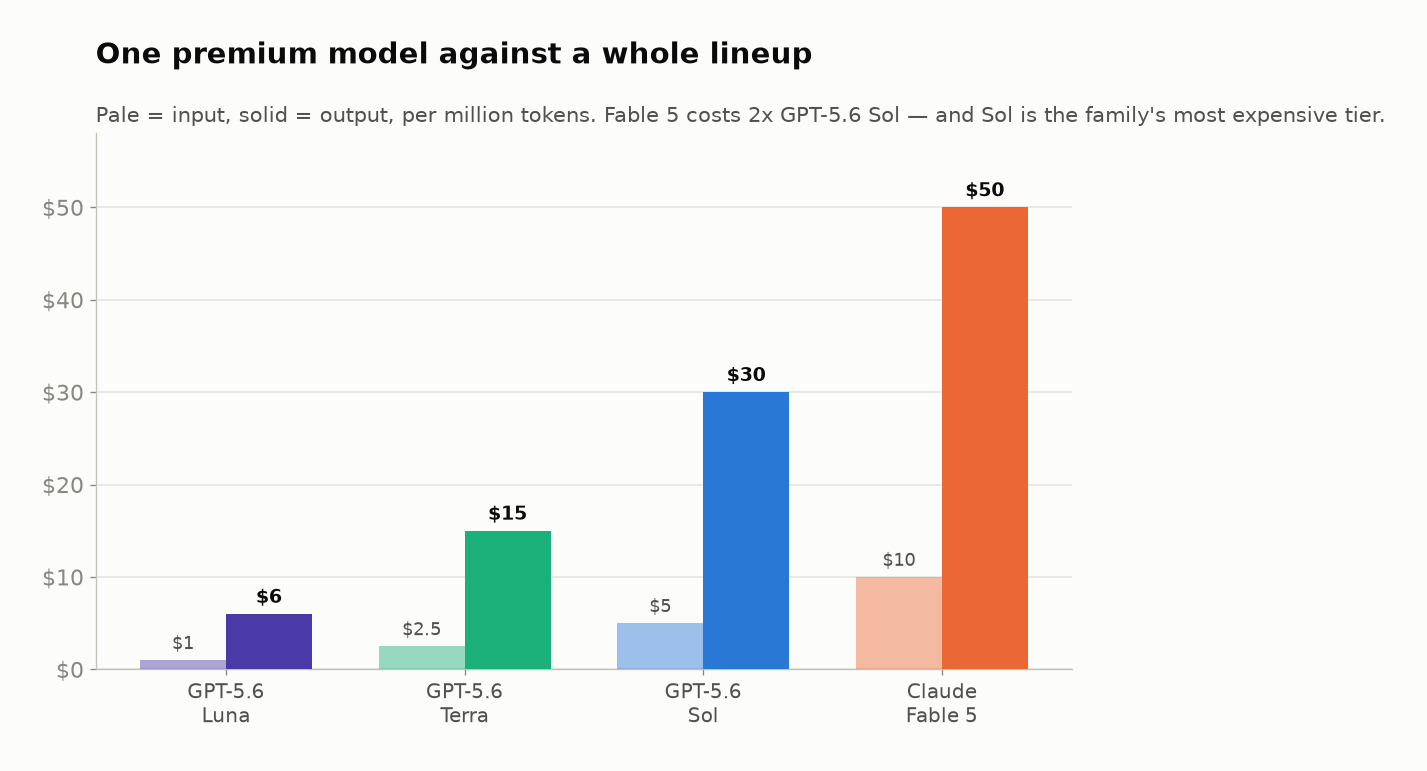
Fable 5 is a single premium model at $10 input / $50 output per million tokens. GPT-5.6 is a ladder: Sol at $5/$30, Terra at $2.50/$15, Luna at $1/$6. So Fable 5 costs twice as much as Sol — and Sol is the family's most expensive rung. Against Luna, Fable 5's output is more than 8x the price.
With Anthropic, you choose Fable 5 or you drop to a different, older model line. With OpenAI, you slide along a single generation's cost-capability curve and pay for exactly the tier your task needs. For a workload that's mostly routine with occasional hard problems, that flexibility is worth real money.
What the premium buys at the very top
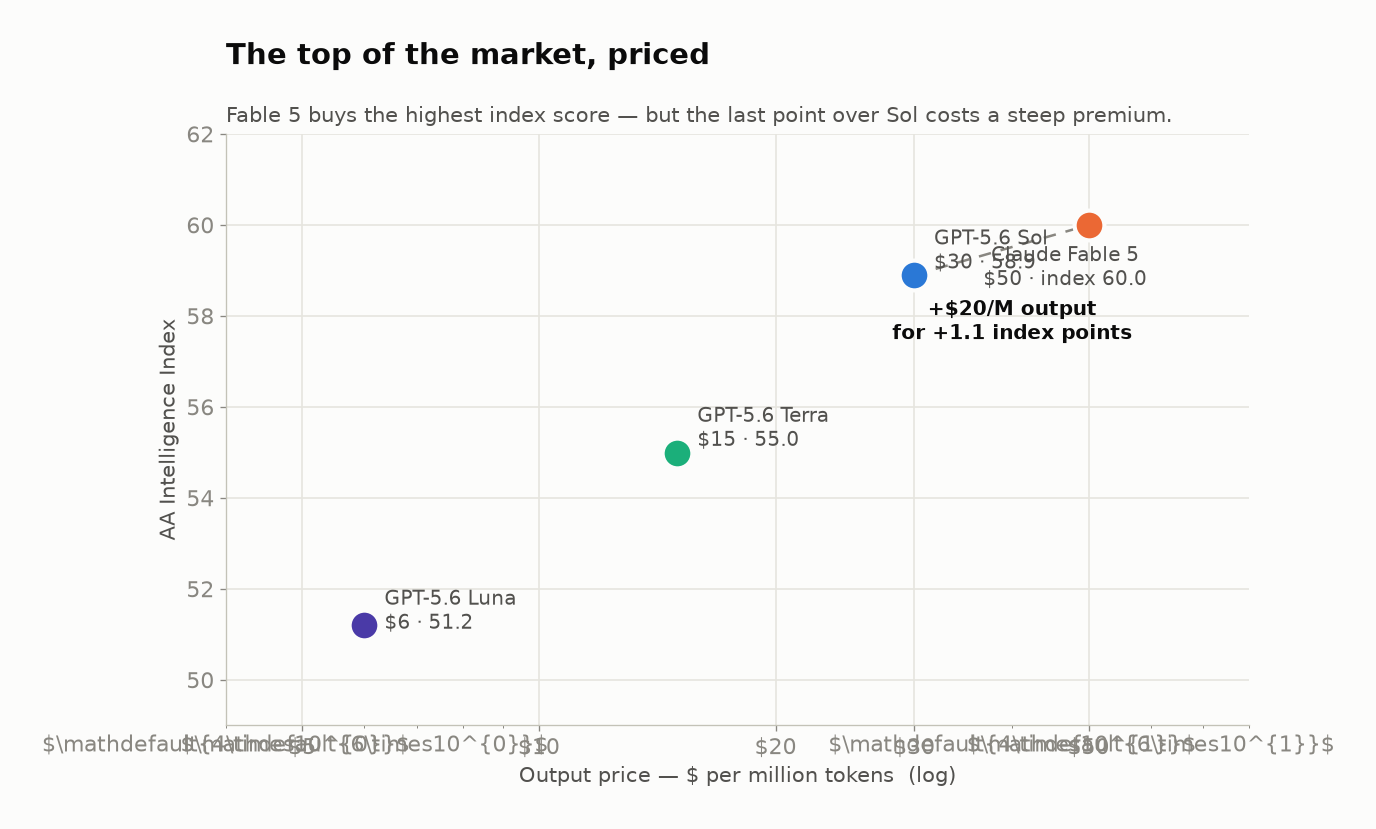
Plot price against intelligence and the premium comes into focus. Fable 5 does hold the highest index score — 60, the top of the market. But the jump from Sol to Fable 5 is +1.1 index points for +$20 per million output tokens. You are paying a steep, specific premium for the last sliver of general capability. Whether that's worth it depends entirely on whether your work lives in the narrow band where that sliver matters — hard coding and low-hallucination reasoning — or somewhere GPT-5.6 already wins outright.
So which one
Stop asking which flagship is "better" and match the model to the job.
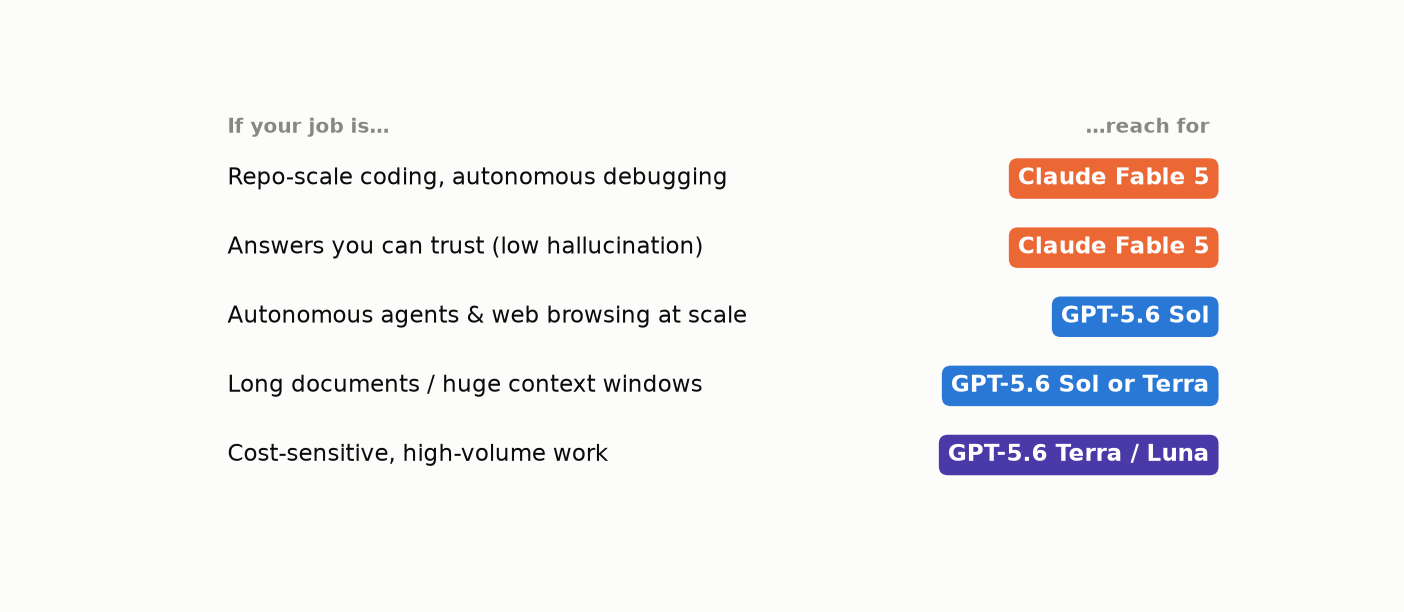
- Repo-scale coding and autonomous debugging — Claude Fable 5. The 15-point SWE-bench Pro lead is the widest, most decision-relevant gap in this comparison.
- Anything where a confident wrong answer causes harm — Claude Fable 5. The hallucination gap dwarfs every capability delta on this page.
- Autonomous agents, tool-use loops, live web browsing — GPT-5.6 Sol. Broader agentic capability, state-of-the-art browsing, and it costs half of Fable 5.
- Long documents and huge context windows — GPT-5.6 Sol or Terra. They have the recall numbers; Fable 5 has a window but no published proof it holds up.
- High-volume, cost-sensitive, everyday work — GPT-5.6 Terra or Luna. There's no Anthropic equivalent to a $1/$6 tier in the same generation.
The honest verdict
Claude Fable 5 is the better model — narrowly the most capable single system in existence, and clearly the best at the two things that matter most for serious engineering: writing correct code and not making things up. GPT-5.6 is the better product — a three-tier family that wins on agentic breadth, long context, and gives you a price for every job instead of one premium bill.
If you can only pick one and your work is hard and correctness-critical, pick Fable 5. If your work is broad, autonomous, or cost-sensitive — which most production workloads are — the GPT-5.6 family is hard to argue against. The frontier didn't produce a winner this round. It produced a genuine, clean choice.
One caveat worth carrying, from running Fable 5 through a fixed set of coding, reading and drawing tasks first-hand: "writing correct code" holds up on the algorithmic problems, but the models at this tier separate almost entirely on careless data handling — comma-delimited amounts and impossible calendar dates — not on reasoning. The measured results are on the model comparison page.
Sources & caveats
Every figure traces to a source below. Two caveats, stated plainly. First, these are largely vendor-published or third-party-aggregated benchmarks; treat the margins as directional and the numbers as accurate-as-of-July-2026. Second, several comparisons are asymmetric — OpenAI published BrowseComp and MRCR figures Anthropic didn't, and Anthropic published a hallucination figure OpenAI didn't for Sol — so I've marked "not published" rather than guessing, and you should weight a missing number as neither a win nor a loss.
- BenchLM — Artificial Analysis Intelligence Index leaderboard (index scores)
- Artificial Analysis — GPT-5.6 has landed (Sol/Terra/Luna scores, Agents' Last Exam, BrowseComp, MRCR)
- Vellum — GPT-5.6 benchmarks explained (per-tier detail, SWE-bench Pro, long-context)
- Claude Fable 5 benchmark detail (SWE-bench Pro, hallucination, HealthBench)
- Anthropic — Introducing Claude Fable 5 (pricing, context window, positioning)