Claude Sonnet 5 vs Grok 4.5: Same Intelligence, and a Price Gap Opening in September

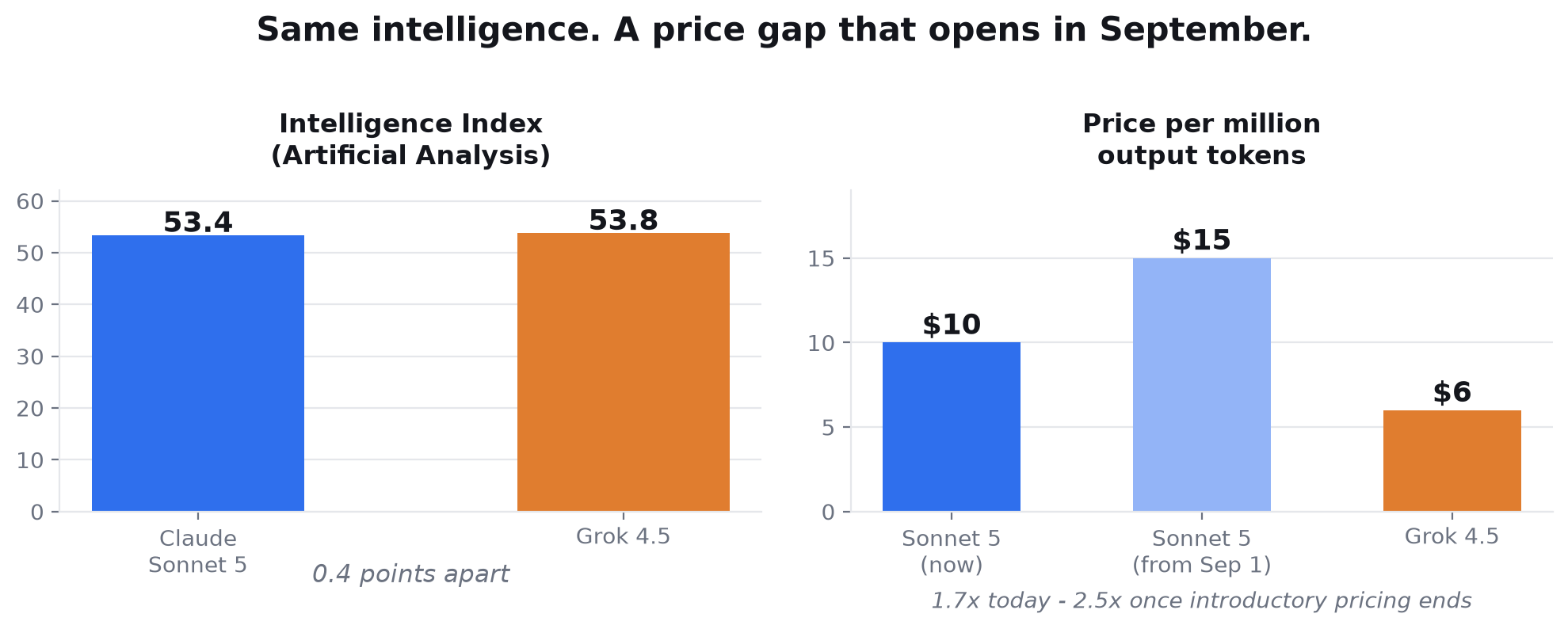
On the Artificial Analysis Intelligence Index, Grok 4.5 scores 53.8 and Claude Sonnet 5 scores 53.4. Four tenths of a point — inside the noise of any single evaluation.
On price, the comparison is more interesting than a straight ratio — because it changes in six weeks. Grok 4.5 bills $2 per million input tokens and $6 per million output. Claude Sonnet 5 is currently on introductory pricing of $2 and $10: identical on input, about 1.7x on output.
That introductory rate ends on 31 August 2026. From 1 September, Sonnet 5 moves to $3 and $15, and the output gap widens to 2.5x. So the honest answer to "how much cheaper is Grok?" is: somewhat, today — considerably, from September.
One subtlety widens it further. Anthropic notes that Sonnet 5 uses a newer tokenizer producing roughly 30% more tokens for the same text. Price per token is not the same as price per unit of work, and that difference lands on the output side, where the meter is most expensive.
The tier this actually settles
One clarification the headline numbers demand, because it changes the decision: matching Sonnet 5 is not the same as matching Claude's best. "Claude" is a line of four models, not one.
Claude's flagship, Fable 5, scores 60 on the same index — roughly six points clear of both models here. Sonnet 5 is Anthropic's mid-tier, built for steady production work rather than peak scores. So what Grok 4.5 has done is draw level with that tier, and undercut it on price. It has not drawn level with the top of Claude's line.
xAI's own launch benchmarks show exactly where the ceiling sits, and they are refreshingly unflattering in places. Against Fable 5 — not Sonnet — Grok 4.5 leads SWE Marathon 29.0% to 24.0%, the long-horizon agentic test. It is effectively tied on Terminal Bench 2.1, 83.3% to 84.3%. But on SWE Bench Pro it trails badly, 64.7% to 80.4% — repo-scale changes are where the flagship pulls away.
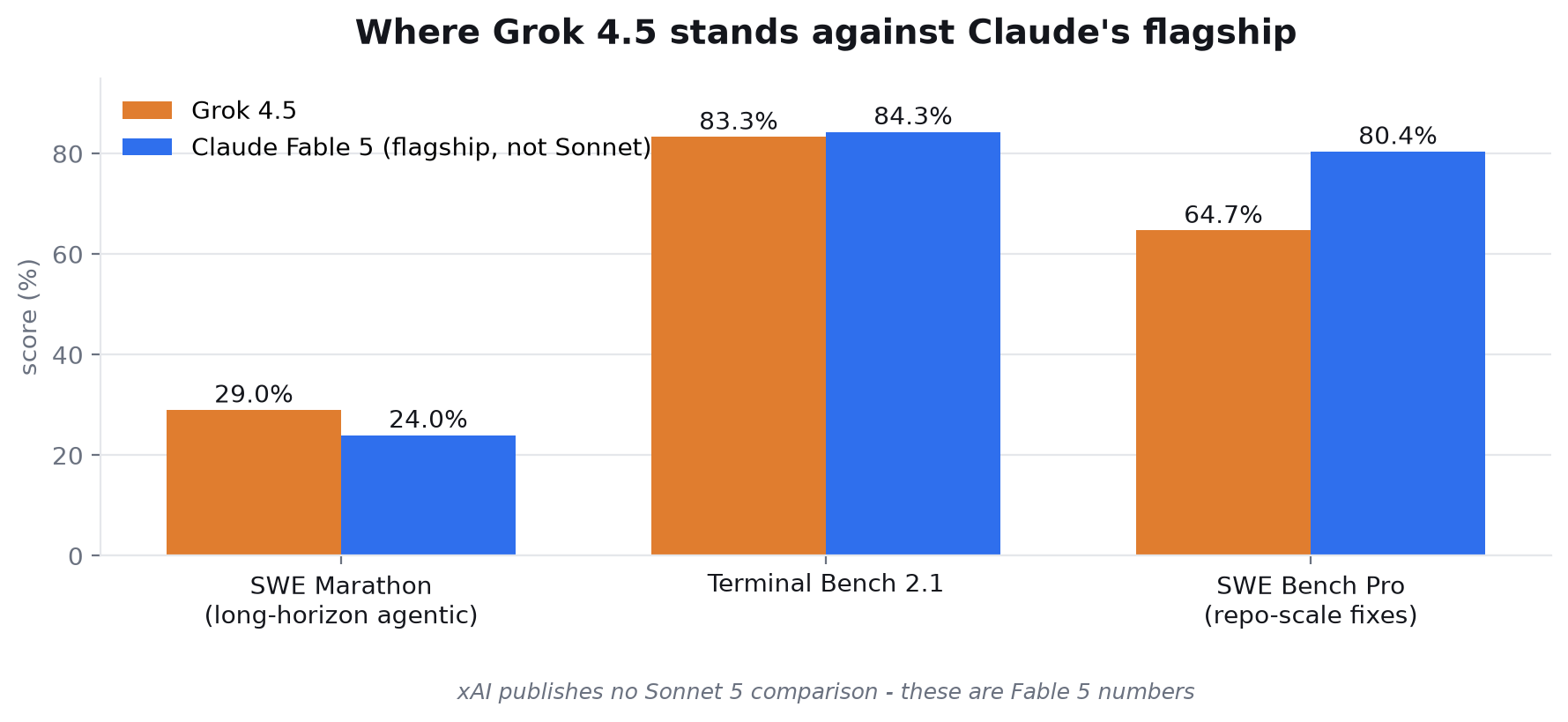
Grok 4.5 competes with Sonnet, not with Claude's best. Within that tier it is the better deal; above it, the tier is the thing you are buying.
There is a second cost lever that rarely makes headlines. xAI reports Grok 4.5 completing SWE Bench Pro tasks in about 15,954 output tokens on average against Opus 4.8's 67,020 — roughly 4.2x fewer. Token efficiency compounds with the per-token price, so on verbose agentic workloads the real-world gap is wider than any sticker ratio suggests.
What our own testing added
Published benchmarks tell you where models rank. They do not tell you how a model fails. So we put both through the same eight tasks — five coding and SQL problems, two long-document problems, and one drawing — using documents written from scratch, so nothing could be answered from memory of the training data. The results tracked the index almost exactly: near-identical, with one revealing exception.
The long-document results were the most useful part, because they measure something vendors do not publish. Given a 51 KB archive of 42 meetings, both models found all five facts buried in it — a budget revised three times, an ownership change, a dated performance target, a count of schedule slips, a rejected vendor. Given a specification with four contradictions planted in it, both found all four, cited the right sections, and neither invented a fifth.
That last point matters more than it sounds. The document is padded with bland filler that practically invites a model to pattern-match a problem into existence. Both declined. If you are pointing one of these at contracts, specs or policy documents, "it does not hallucinate issues that are not there" is worth more than a leaderboard position — and no public benchmark will tell you it.
Asked to parse a messy bank statement, both handled the hard parts — three date formats, two negative-number conventions, stable ordering. But amounts carried thousands separators, and lines were comma-delimited. Grok split on the first two commas only. Sonnet split on every comma, so every row containing ₹1,234.50 broke into too many fields and was silently dropped — no crash, no warning, just the largest transactions quietly missing from the output.
That was the only separation across all eight tasks — on the coding set Grok went 20 for 20 against Sonnet's 19. One sample, not a verdict — re-running that parser four times in fresh context, Sonnet passed cleanly all four times, so the dropped-rows failure was not its usual behaviour. But it is the failure mode worth internalising: at this tier the models rarely fail loudly on hard problems. They fail quietly on careless edge cases, and that is invisible to every leaderboard.
That held up. These tasks have since been expanded and run against nine models, four times each, and the comma trap is still the thing that separates them — it also catches Claude Opus 4.8, which misses it in three runs of four. Opus 4.8 finished last on the six-model run this paragraph originally described; on the current nine-model table it places third, because the scoring now reports each model's average across runs rather than its worst single run, and Opus 4.8 is streaky rather than weak. The running results, with every prompt and each model's raw output, live on the model comparison page, updated as new models are tested.
The other thing worth showing is how alike they are when the task is open-ended. Same prompt to both — draw an auto-rickshaw towing a server rack up a hill in the rain — first answer taken, no retries:
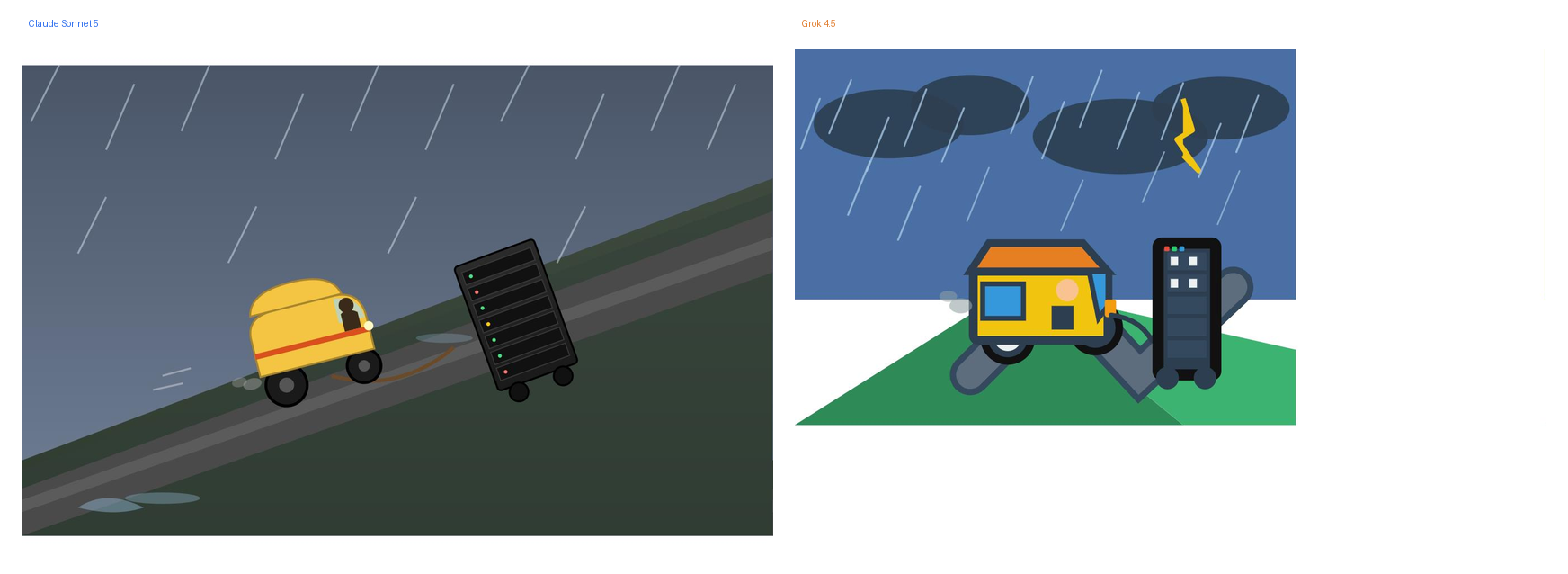
Both got the scene right on the first try: the slope, the tow line, the rack, the rain. If you were handed these without labels, you would struggle to say which model produced which — which is rather the point.
So which one
- High-volume or long-running agentic work — Grok 4.5. It leads the long-horizon benchmark, costs less per output token, and uses fewer of them. Both effects compound, and both grow in September.
- Hard, repo-scale changes where correctness is expensive — Claude Fable 5, not Sonnet. The 80.4% to 64.7% gap on SWE Bench Pro belongs to the flagship; buying Sonnet does not buy you that number.
- Document review — contracts, specs, long reports. Either, comfortably. Both recalled every buried fact and flagged every real contradiction without inventing one, which is the property that actually matters for this work.
- Anything parsing messy real-world data — trust neither by default. Both are strong here and both can fail silently; feed them your ugliest inputs before shipping.
- Everything else — today it is close enough that either is defensible. Revisit on 1 September, when the same choice costs 2.5x more on output. At 0.4 index points apart, that needs a reason more specific than "it's the better model".
Sources & caveats
- Index scores: Artificial Analysis Intelligence Index, July 2026 snapshot. Per-benchmark figures and token efficiency: xAI's Grok 4.5 launch post (16 July 2026) — vendor-published, and competitor numbers there are drawn from each lab's own cards. Claude pricing, the introductory-rate end date, and the tokenizer note: Anthropic's own pricing documentation — both labs' prices here come from the vendor, not a secondary report.
- Our hands-on run was a single pass through each model's chat product at default settings — enough to surface a failure mode, not to rank them. Treat it as an illustration, not a measurement.
- Grok was accessed through its chat product, which does not display the served model version. xAI published Grok 4.5 as its flagship on 16 July, so this is almost certainly it.
Companion pieces: Fable 5 vs GPT-5.6 on how the flagships split the board, Kimi K3 on open weights arriving at frontier prices, and the cost-per-task map of the whole field. The pattern across all three is the same: the top of the market is converging on capability and separating on price.